First, the disclaimers and caveats. And there are a lot.
(1) I am not an “AI guy.” As the title notes, I’ve used ChatGPT more in the past 2 days than the rest of my life combined. If you are an “AI person,” you 100% know more about this stuff than I do. If I have anything completely off, send me an e-mail at Joshua@BeyondNonJD.com and I’m happy to correct/update, with a h/t to you. I’ve used ChatGPT, AI, and GenAI, throughout the piece to mostly mean something similar (I know!), though I only ran the prompt on ChatGPT (I know there are other models).
(2) I am sure I could do much more with AI, but my real focus is learning more about it for part of one unit in LEALS. That breaks out into two strands I’ve been focused on, neither of which have required me to use it. (1) How law students at U.S and other global law schools are being trained to navigate it and (2) how lawyers are getting into trouble when using it in the United States.
And so as I prepare for my first full LEALS in a year, there have been enough new stories for both to keep me busy. I’ve couched my ChatGPT module in the broader context of professional responsibility, legal research, and legal citations. So if you are using Lexis/WestLaw and understand how to cite check (hooray law journals!) and paid attention to the rules of professional responsibility, the guardrails seem to be just as strong. From the limited things I’ve seen in the news, it seems like people taking shortcuts/not reviewing work. But again, not an expert.
(3) Nothing about the orders are my own views. I spotted a couple things that made me scratch my head, precisely because of how ChatGPT “gets information.” So please do not try to say that the new Joshua Alter T14 LL.M. ranks have just dropped.
I am not including the lists for that reason, though you’re welcome to use the prompts and see what you get.
In fact, try some I didn’t because how you ask a question and what words you use may change the list orders. And a related point: grouping together the schools traditionally known for their BigLaw J.D. rates and prestigious locations on USNWR rankings may not even be appropriate for LL.M. programs. Are any schools outside the T14 “better” for international LL.M. students? What are we even measuring when post-LL.M. employment outcomes vary considerably, data isn’t even tracked for regulatory/accreditation purposes, and the ABA guidance leads different schools to treat their LL.M. (and overall Non-J.D. operations) different.
(4) Getting on ChatGPT over the past two days has been inspired by a recent PreLaw article and the pushback from Mike Spivey and the ensuing discussion on LLMs and AI and getting clicks. All way outside my bailiwick, but at least got me curious.
If (i) ChatGPT gets its information from the web and (ii) anyone can put information on the web and (iii) we assume students will use ChatGPT, what information are students currently accessing?
[Disclosure: I am currently (since 2022) a Contributor for the International Jurist (on the same website as PreLaw) and write a monthly article for them in that capacity].
(5) With the caveat above, I’ll conclude after the three prompts (Prestige then Selectivity then Support). I do not attempt to “rank” them because what would I be ranking them on? A lot of online information about LL.M. programs (where ChatGPT is accessing information from) is really, to me, marketing wrapped up as information. Can ChatGPT tell the difference? And should schools be penalized because they’re not spending as much time marketing their programs on their websites with SEO strategies?
So ChatGPT should be used with caution. And that is why I spend so much time on public-facing writing. I think it’s a bad idea for me to rank/grade LL.M. programs on incomplete information. But I can at least give you some tools as you decide which programs are the best fits for you. And if that gets added into the machine that feeds ChatGPT, at least (I hope) there is some more expert, balanced, and thorough information out there.
Prompt #1: Prestige
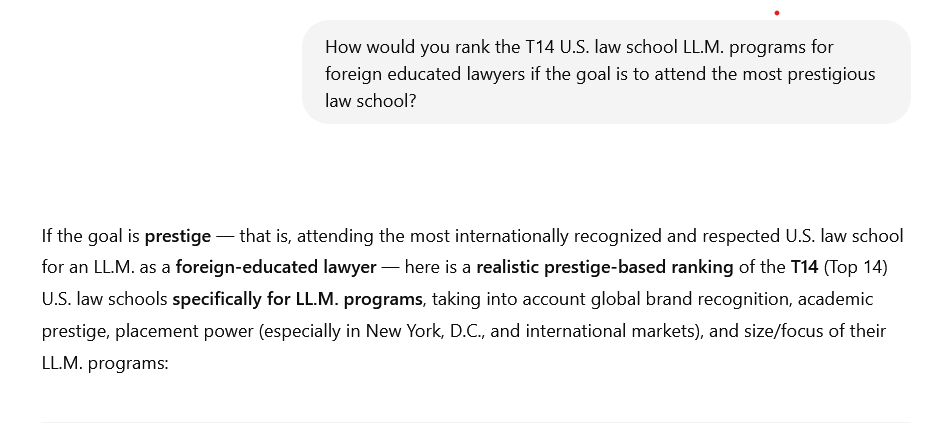
The LL.M. is many things to many people. But something I’ve seen throughout my career working and teaching at law schools in the U.S. and abroad, is that LL.M. prospects, students, alumni, and schools often talk about prestige. A lot of my students have a “dream school” or “dream schools.”
What does prestige represent? In one way, the ability to convert two semesters of affiliation with a U.S. law school brand into your future life, future earnings, and future career.
But as I chatted about with Carlos Romero, what about prestige in one market versus another. If a law school has a limited presence in your home market, is it better to go to a school that is slightly lower down the list but that opens doors in your home market?
What about the differences between J.D. prestige versus the LL.M. program? Using the J.D. as a proxy could go either way.
Prompt #2: Selectivity
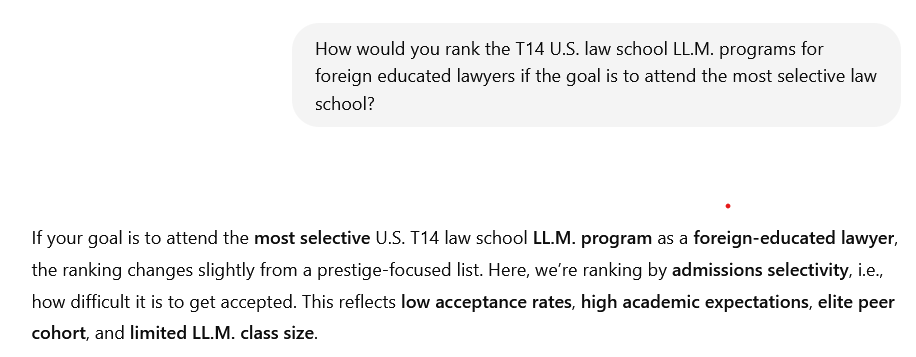
This is where the ABA Required Disclosures make the J.D. sorting so much easier and the LL.M. sorting so difficult. What data goes into acceptance rates? What if a school has multiple LL.M. and Non-J.D. degrees with different selectivity and class sizes?
The peer cohort one was really interesting, and something Maricela Munoz and I briefly discussed on the latest episode of her podcast. But how can ChatGPT really assess that? Are the credentials within the LL.M. class roughly similar or is the program more “top heavy” and “bottom heavy?” when it comes to ranges of things. And to be fair, some J.D. programs at least have to think about that as well, especially when you look at LSAT and GPA bands from the 75 to the 25 percentiles.
Prompt #3: Support
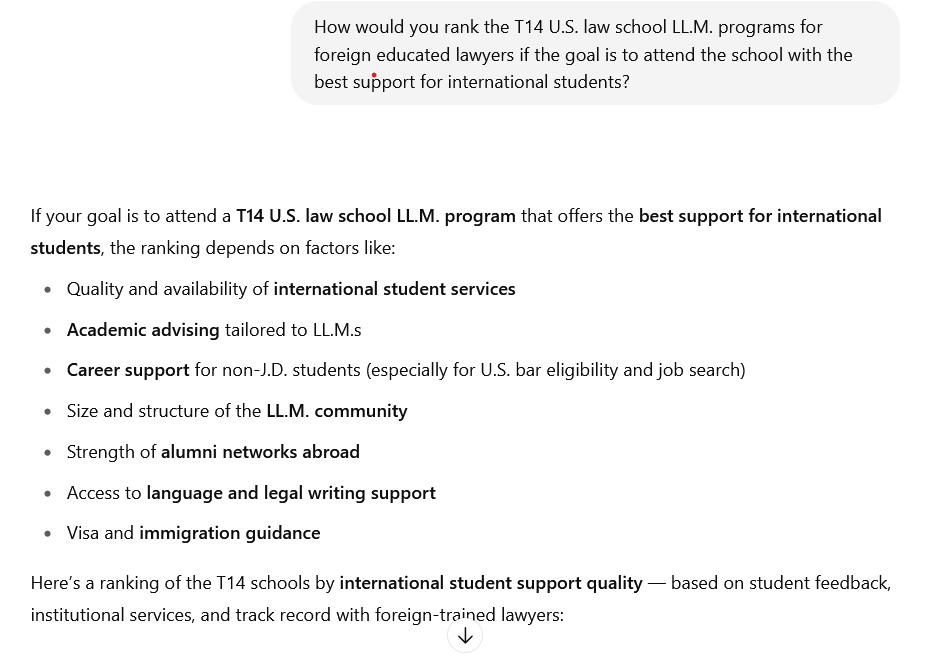
While the first was about what comes at the end and the second about what comes at the beginning, the third is about what happens in between. How do you feel in your program? This one is a little tricky, because asking this question in different ways can produce different answers.
I did like that they highlighted bar exams and jobs, because that is what so many residential LL.M. students are thinking about, even if those are the things the U.S. law schools are in the weakest position to support on compared to the other “student services” and “student experience” type activities.
And like other things, how you balance these matters a lot. Have a green card or are a U.S. citizen? Maybe how strong the alumni network is abroad and immigration services are not particularly relevant since your life is now in the United States.
Concluding Thoughts (For Now)
So what was the point of that experiment? What did I “accomplish?” Other than starting to become (slightly) better at using ChatGPT?
- This is the start of a larger series of posts and so I’m ending it without coming to any earth-shattering conclusions or revelations. Similar to a scene-setting episode in your favorite show, the pieces are now on the chess board to explore at a later date.
- This was good for me. Not because I’m focused on automating LEALS or my work. As people get more frustrated with their self-checkout kiosks and automated phone support, I’ve focused even more on what makes me, well, me. I can’t scale what I do, but I’m not trying to. LEALS has always been a small course, and my support is focused on a very limited number of students and lawyers abroad. Frustrations with automation, in a very interesting way, are actually really good for me (as I approach 40, query whether I’d say the same thing if I were 20 in 2025).
- But, it was good for me, because I’m now going to start using it more, alongside my students, to see what questions they’d have after a module, if they’re feeding notes or PPTs into it, and to just get a better sense of what they use it for. LEALS is a pre-LL.M. course really, and so my students get handed off to the experts, whether that’s legal English, Constitutional Law, or Legal Writing. I stay in touch with a lot of students, but how they use GenAI is not something we’ve discussed. Until now!
- What I’ll probably dig into next: a lot more into each of the lists, think about other factors that ChatGPT could make realistic lists for, start to see where most of the information is coming from, write on information I feel is “off,” to help better the information it uses, see how other GenAI models differ or reinforce the same information, and much more.
- It’s not a secret that I planned to continue writing free and accessible information. But my interest in doing so is now even greater based on what I’ve seen. If people are going to find information, I’m more comfortable with them finding information from me.
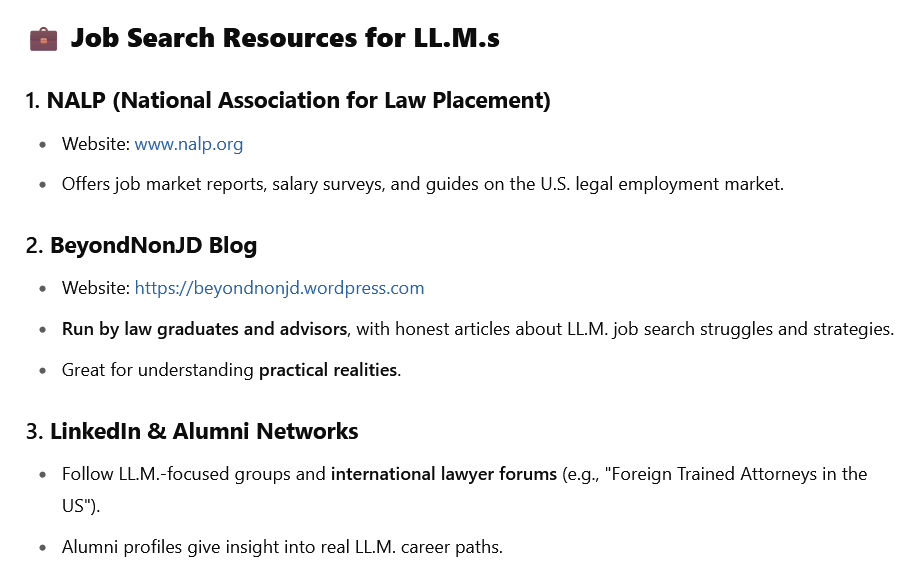
 Beyond Non-JD | by Joshua Alter
Leave a reply to Alter continues focus on international LL.M. students as U.S. higher education undergoes transformative change – Nationaljurist Cancel reply