Each Friday I’ll share an article I’ve written in the past with 3-5 quick (read: quick for Josh) thoughts. Today’s article? My latest piece in the International Jurist’s 2025 issue. You can read here (https://bluetoad.com/publication/?i=846903) and my article starts on page 4.

1. When discussing bar exams, almost everything has a caveat. Taking a State Bar Exam? D.C. is not a State! Eligible after a qualifying LL.M.? Well that may depend on your first degree in law! Passing the bar exam makes you an attorney? There are other tests and requirements outside the two-day marathon to become licensed. No piece that I write can capture every nuance, permutation, or situation. And LL.M. programs aren’t trying to be difficult by hedging and using caveats when advising, especially for prospects. Ultimately, the states, through their courts and boards, make these eligibility determinations. Not us!
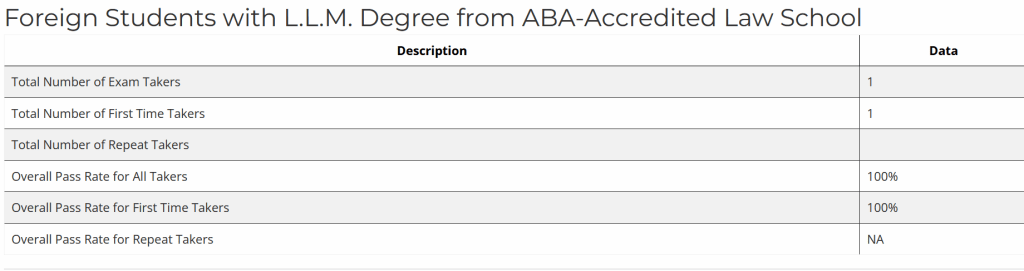
2. There are a lot of States where foreign attorneys can qualify for a Bar Exam. I usually focus on civil law trained law grads/attorneys, especially given where I teach abroad (primarily China). I focus on the jurisdictions (see, not States!) that the most LL.M. students tend to ask me about and/or the ones with the largest numbers of takers in this piece, but also the ones where the most public information exists (e.g., Georgia) and ones that for other reasons I am curious about (e.g., Florida). But you can look up each state through the NCBE chart and then Google the specific rules and requirements. A good example: Paula Marques Merlin shared that she passed the Indiana Bar Exam. When I looked at the February 2025 statistics for the foreign students with LL.M. degree from an ABA-accredited school, it looked like 1 student took the exam and 1 student passed. Where there is a will, there may be a way.
3. For most people without a U.S. J.D. I speak with, bar licenses after an LL.M. degree are a means to an end. And that end usually has to do with careers. For some that can be getting a job as an attorney in the State they secured bar admission in. For others, it can be to access federal courts for an area of practice (e.g. immigration law) where the specific state of license isn’t as important. For others, it’s a credential that helps with entry-level or lateral jobs abroad in ways that are too complex for a short post. But that I’ll discuss in more detail at some point, especially related to those who return home immediately after the bar exam or after the OPT. But the idea is to figure out why you are seeking to be barred and plan around that. And why you may hear discussions about “whether a bar exam makes sense as part of your LL.M. degree.” For the most part, I don’t think that’s gatekeeping by law schools, since LL.M. and J.D. programs are different (see below!).
4. J.D. programs have to pay careful attention to pass rates for accreditation purposes and because of the consumer protection requirements in the form of ABA Required Disclosures. See this TaxProf Blog post about the 75% threshold to learn more about J.D. programs and the pressure for some schools on bar pass rates. Schools may have very different admission standards for LL.M. programs, something the ABA at least hints to on its website discussion of Non-J.D. programs. Trying to game out likelihood of passing is difficult for a host of reasons I’ve covered in the past. Taking a July 2025 exam? Don’t pay too much attention to the statistics (though I’d advise a little different if you’re planning an LL.M. for 2025-26 or you graduate in December 2025. Instead, focus on your commercial bar prep course and working hard this Summer. But using your J.D. program’s pass rates to try to assess your situation is likely not going to be a good idea. The same may unfortunately apply to employment outcomes.
5. We know that many LL.M. students are choosing their programs with a bar exam in mind. The conversation about whether LL.M. programs are/should be one-year bar prep programs is a story for another time (another one on my very long to do list!). But looking around U.S. law school websites about how LL.M. programs and bar exams are discussed can help you. There are things where you can make an argument that the more LL.M. students “win” (e.g. scholarships) the more likely it is that the law school “loses” (e.g., revenue). Having as many of your LL.M. students as possible pass a bar exam seems like a win-win to me. Can’t practice without a bar license in the U.S., easier to get a job with that credential (unless going into an alternative career), and likely to look back on your LL.M. more fondly if you pass than fail, at least in my encounters with LL.M. grads overall. That gets into trickier discussions for another time.
Any errors? Send an e-mail to Joshua@BeyondNonJD.com and I’ll make the revisions in bold underline.
 Beyond Non-JD | by Joshua Alter
Leave a comment