When State Bar Exam results are released, we get plenty of information. You can see press releases from bar examiners/courts to learn about the statistics and how schools compare (the Florida example for July 2023 is here). You can read news stories about trends at the state and national level (an example for July 2023 MBE scores is here). And you can see a lot of schools highlight their pass rates on their own websites, at least when they are good or improved from the prior year. You can even review every ABA law school and their Bar Passage Outcomes over the years on the ABA Required Disclosures website.
But there is an important caveat. This information is almost always for J.D. students. But why?
Shouldn’t LL.M. students also have this important consumer protection information? Wouldn’t this be helpful for LL.M. applicants when they are in recruitment sessions when bar exams are mentioned? Schools with really great LL.M. bar passage rates would be able to highlight this information in marketing. Schools with weaker LL.M. bar passage rates could evaluate whether they need to provide more resources for LL.M. bar takers or reassess their admissions practices.
I write a lot about why I think we should have more transparency and disclosures related to LL.M. programs. While there is likely going to be progress in U.S. higher education more generally soon, I fear that a lot of those benefits will not fully make their way to LL.M. students.
But one area where I feel more confident is State Bar Exams. Why? Georgia provides a great example that it is feasible to be more transparent with LL.M. pass rates. The starting place is the Supreme Court of Georgia’s Office of Bar Admissions website.
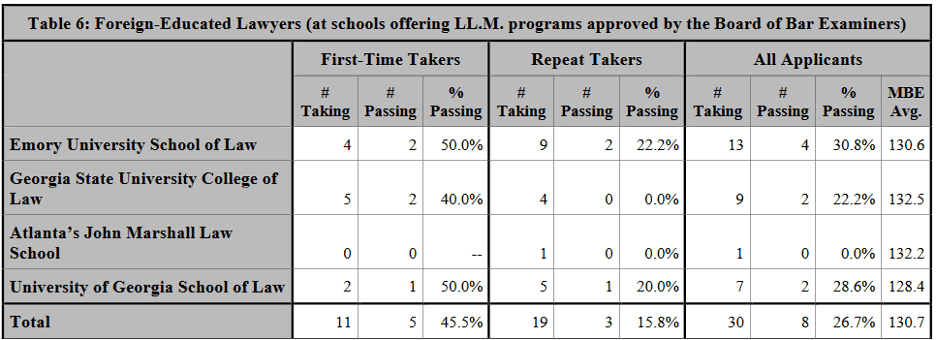
Let’s take a look at the February 2023 Georgia Bar Examination Statistics. On page 2, you’ll see Table 6: Foreign-Educated Lawyers (at schools offering LL.M. programs approved by the Board of Bar Examiners).
First, an important caveat. This is not to “pick” on the Georgia schools. I applaud them for working with students in such a high-stakes visible way. The Georgia schools know that their LL.M. students who choose to take the Georgia Bar Exam will be quite visible, compared to their LL.M. students seeking admission in other States.
Georgia is probably not the first State you think of as an LL.M. Bar Exam “destination” State. Between 4 Georgia schools, statistics show only 30 LL.M. graduates who took the bar exam. 8 passed for a 26.7% pass rate. You could also look at the July 2023 statistics (1 of 26 passed for a 3.8% pass rate), February 2022 statistics (1 of 18 passed for a 5.6% pass rate), and go back to get a full picture of LL.M. pass rates.
New York is a very popular State for LL.M. students to want to sit for a State Bar Exam. And New York is willing to share statistics related to the different groups of people who sit for their State Bar Exam. Looking at the February 2023 press release, we see:
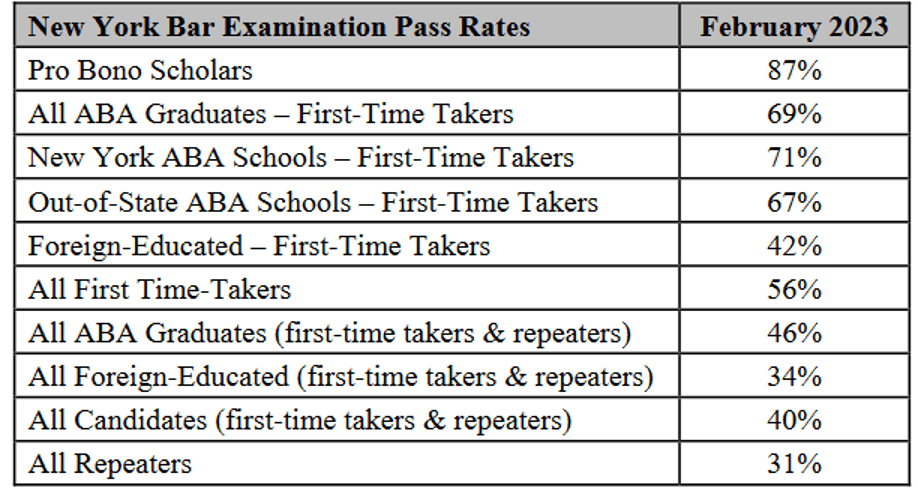
34% for all foreign-educated sounds pretty good, especially compared with Georgia’s February 2023 results (and other past results). But the question for me is who is part of this group? Certain law school graduates trained in common law jurisdictions do not need an LLM to sit for the New York Bar Exam. I would be curious to know if New York’s BOLE could break out that group into (1) those who required an LL.M. to qualify and (2) those who did not require an LL.M. to qualify. While people who already qualify can still take an LL.M., just seeing if the foreign-educated numbers are different would be enlightening.
The other thing that New York (and all States) could borrow from Georgia: sharing pass rates for those who qualify by school. Beyond Non-JD readers have shared LL.M. pass rates would be important and I agree. Why?
Because the ABA Required Disclosures do not apply to LL.M. programs, LL.M. programs are incentivized to not share that information. If you share during a good year, what happens when you have a bad year?
If there is difficulty getting law schools, accreditors, and regulators to share more LL.M. (and Non-J.D.) information, State Bar Exams can build momentum for more information. Why do I think this is important?
- If schools know that LL.M. bar pass rates are public, schools will be more incentivized to focus attention on it. If prospective students know that LL.M. bar pass rates are public, they can use that information to have more meaningful conversations with U.S. law schools. For example, I see your LL.M. bar pass rate for New York is 75% last year. What do you think helped the group that passed to be successful? What do you think caused the 25% who did not pass to struggle? Or if the statistics are bad. For example, I see you did not have any LL.M. students pass the bar exam last year. What kind of support are you offering this year to help improve that?
- Schools that heavily advertise paths to bar exams would need to assess their admissions criteria. LL.M. admission rates aren’t public information, but as U.S. law school Non-J.D. operations continue to expand and focus on creating more revenue, I think schools could make “protect” their LL.M. programs more than they did in the past. Ensuring that students who are admitted are positioned to pass a bar exam is important for many reasons. After all, for LL.M. students who want to practice as attorneys in the U.S., they’ll need to pass a bar exam. If schools are finding it very difficult, they may need to assess their TOEFL/IELTS cutoffs, the amount of bar exam programming they offer, etc. For example, I can see situations where schools that rely heavily on LL.M. students whose main priority is a bar exam to advertise more about specialized support that comes with their programs.
- This gives less famous/lower-ranked schools a chance to shine! The current rankings are not designed for LL.M. programs, and helping foreign-educated lawyers become practicing attorneys in the U.S. is an important focus for those of us who work with international LL.M. students. Especially for foreign-educated lawyers who are already living in the U.S. and have no plans to leave, making sure your program can help them with their goals is important. So I can see a situation where “lower-ranked” schools that shine or bar passage support come together around this idea.
Some might say that the purpose of an LL.M. program is not to help you pass a State Bar Exam. Instead, it is for the education, the network, and the experience. To that, I would suggest looking at how LL.M. recruitment and marketing focuses on the bar exam as an important part of the LL.M. “sell,” especially for civil law trained candidates seeking admission to a State Bar like New York. Bar exams are important as talking points and PowerPoints. Doing what we can to ensure that the students in our program pass State Bar Exams is a good thing to do, but it’s also a good business strategy. Happier alumni able to practice law in the United States seems like good news for alumni offices, career offices, and marketing teams!
More States should follow Georgia’s lead! How can this become a reality?
- LL.M. graduates who have become licensed attorneys in U.S. States can play an important role in this endeavor. As members of their State Bars, they can help drive change. I suggest that LL.M. students who work with LL.M. graduates as mentors, interns/externs, or through their schools seek ideas for the easiest ways to get this idea before their respective courts/law examiners.
- Prospective LL.M. students can make bar passage information an important part of their research. Schools can answer questions about bar passage however they choose, and there are important caveats to a school’s LL.M. bar passage rate. But as consumers of U.S. legal education, applicants can decide how much weight to put on a school’s bar passage rate. While schools may not track every single bar exam result for every LL.M. student, questions about recent bar exam results do not seem unfair to me.
- Current LL.M. students who are worried about bar exams can speak to their schools about how past students fared. If a school has strong LL.M. bar pass rates, my guess is that means either (1) they bring in a very strong entering class each year; (2) they offer a lot of support to LL.M. students (either as part of a wider law school focus or LL.M. specific); or (3) a combination of the first two. If a school has strong LL.M. pass rates and no specialized support or minimal support, you may hear a lot about enrolling in commercial bar prep courses and taking them seriously as the process for achieving success. That was how many J.D. programs, including mine, worked way back in 2010-2013.
The overall idea behind this? If helpful information makes sense for J.D. students, it seems like that information should also be available for LL.M. students. While I understand that there are important distinctions between J.D. and LL.M. programs in many ways that would make it hard to “compare” across every category (e.g., employment scores), I think sharing bar passage information is a simple and important change that can make a difference. If that cannot as easily come from the law schools, maybe we can all follow Georgia’s lead for more LL.M. information through courts/bar examiners.
To be clear, disclosing LL.M. pass rates would require schools and prospects to think through the meaning of this information. It can be more nuanced than just the raw number.
- For prospects, a singular pass rate number does not tell you about the individual takers or you. For example, the amount of hours students devoted to bar prep, whether they signed up for a commercial course, etc. You won’t be able to tell pass rates based on TOEFL/IELTS or based on scholarship size. And so whether a school has strong numbers or weak numbers, you are likely going to want to focus on your situation. How does your background and strategy align with past takers? Determining if the school you’re going to is one where most people take a bar exam, most people do not take a bar exam, or there is a split, can be helpful as you consider the type of program you’re most interested in. But it won’t tell the full story.
- For schools, talking about pass rates will be crucial. For example, students who have entering credentials that indicate a potential struggle may want to consider three-semester programs for a longer runway. Or, a summer program before they begin their studies for a turbocharge on language, courses, and preparing. Schools can create more programming around LL.M. bar prep to help these students. Some schools may develop plans for students to wait until the following bar exam and offer prep while students are working post-LL.M. (admittedly a tough balancing act). All that to say, students will still enroll in LL.M. programs for many reasons. Understanding those who are prioritizing bar exam success over other factors (e.g., prestige, price, program) can help schools allocate resources to these students.
We can work on this together. Let’s create a rising tide that lifts all boats by helping more LL.M. students pass bar exams and more schools ensure alumni feel their programs were a “success.” Instead of running from disclosures and transparency, let’s embrace an initiative like this.
 Beyond Non-JD | by Joshua Alter
Leave a reply to State bar exams can lead the way in the nascent LL.M. transparency movement – Nationaljurist Cancel reply