Today, I’m focused on the differences between LL.M. tuition v. the law school cost of attendance (COA) v. the actual cost of experience (COE). The ultimate takeaway: if you are enrolling in a fully residential General LL.M. to sit for a state bar exam, it is important to pay attention to these differences.
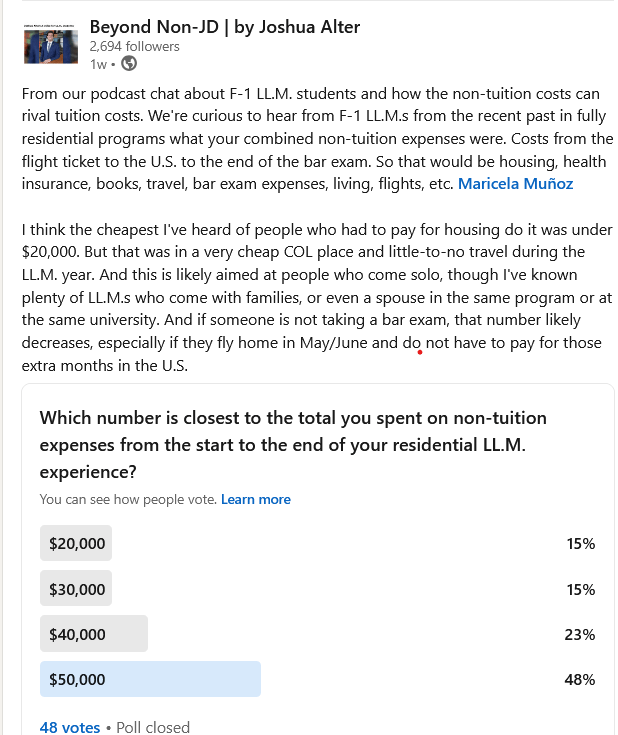
Beyond Non-JD readers have helped me highlight this point clearly. Especially for those planning to sit for a state bar exam at the end of their programs and planning to study in high cost-of-living cities. Thinking about $40,000-$50,000 USD in non-tuition expenses for the full 12-month experience may be helpful. Though of course, individual choices on things like rent and discretionary spending also play a huge role.
And this entry is not meant to say LL.M. programs are keeping this hidden or a secret. From reviews of admission letters on RedNote and law school websites, and from my own experiences at three U.S. law schools, I am confident there are already discussions about this. But after speaking with a number of people who either didn’t fully understand this or fully grasp the costs, I thought it would be good to reinforce before the 2025-26 year.
As you may have guessed, I am more focused on sharing generally helpful information than dictating how each school should approach the LL.M. + bar exam + costs discussion. If one more person goes into the 2025-26 year with a better understanding of the differences, this entry will have been worth it!
LL.M. Tuition & LL.M. COAs
LL.M. tuition refers to how much you will pay your law school for your LL.M. degree. Sticker tuition is the listed price, though many LL.M. graduates and students and admits speak very openly about the tuition discounts they received/were offered, generally referred to as scholarships. There are important discussions about different prices for different schools, as well as which students pay the most and which students pay the least (even within the same LL.M. program), etc.
But for F-1 General LL.M. students planning to take a fully residential program to qualify for a bar exam like New York, that is only one part of the equation. Next, you’ll likely see the Cost of Attendance (COA), the law school’s estimate for how much for LL.M. program is expected to cost.
This is important for the I-20 and to ensure you have enough funds to secure the F-1 visa. From the admission letters I have seen on RedNote and reviewing some school websites, it appears schools are generally pretty open that these are generally two-semester or nine-month estimates. Some students may live in luxury apartments while others might share a bedroom. Students will spend different amounts, but the idea is that this guide, including housing, insurance, books, etc., will serve as a good estimate from orientation to graduation.
You don’t want to run out of money during the LL.M. year, obviously. But you probably also don’t want to have to decline nights out with your classmates, winter and spring break trips with your friends, and other expenses that play a big role in the non-academic side of the LL.M. year. So knowing how much to realistically expect to spend depends on both the easy-to-calculate costs (health insurance for F-1 students, books, etc.) and the ones that really depend on you (rent, travel budget, etc.).
Cost of Experience
But for the international LL.M. students I described, the bar exam add-on is important to pay attention to.
We know that many LL.M. students are taking fully residential programs specifically to meet New York’s requirements (or similar requirements in other key jurisdictions). New York eligibility, even more than a potential OPT, receives the most votes when I run polls about the biggest draw for a residential LL.M. in the United States.
My January 2023 piece in the International Jurist covered this. And so the information has been out there for plenty of time. Ultimately, if you’re taking the New York Bar Exam (or a similar in-person exam) at the end of your LL.M., you’ll want to think about the costs for a 12-month experience with a bar exam.
The way I think about it? Think about how much it will cost from the day you fly to the U.S. until the day you fly home after the bar exam (unless you will stay for OPT).

But it is nice to see more people pay attention to this. Maricela Muñoz dedicated an episode of her podcast to this topic!

Why Separate?
As you may have guessed, I’m not coming down on one side or the other. No one is “forcing” you to take a bar exam. It is not required to study in an LL.M. program. And so this is not a post about U.S. law schools “needing” to add that to the COA. It may also confuse LL.M. students who are not eligible or those who are not particularly interested in a bar exam. And schools and students will have different bar prep costs.
Law schools generally know how many of their LL.M. students are planning to sit for bar exams. Even at schools that do not center the LL.M. experience around a bar exam (and there are valid reasons for that!), they complete the Certificate of Attendance forms as you finalize your eligibility. And many LL.M. programs have at least one person who is a bar exam “point” person, even if that is to direct you to state boards for information.
So it is helpful when schools also share information about those added costs as incoming students finalize their plans and budgets. Especially if they know the majority of their students are sitting for bar exams upon graduation.
Ultimately, this post is more about proper planning and expectation management. Make sure that paying for the bar prep course, bar exam registration, and travel expenses don’t put you in a difficult or uncomfortable position.
Because the stress of the bar exam after an LL.M. is already enough. Thinking about your finances and if you’ll have enough money to get over the finish line are equally important.
 Beyond Non-JD | by Joshua Alter
Leave a comment