TaxProf Blog is a great resource for aggregated insights into U.S. legal education. It is also a go-to spot for tax law developments, which meant I spent even more time visiting the site during my three years working at University of Florida with its Graduate Tax Program. The third pillar of the site, focused on faith, is particularly visible on Sundays.
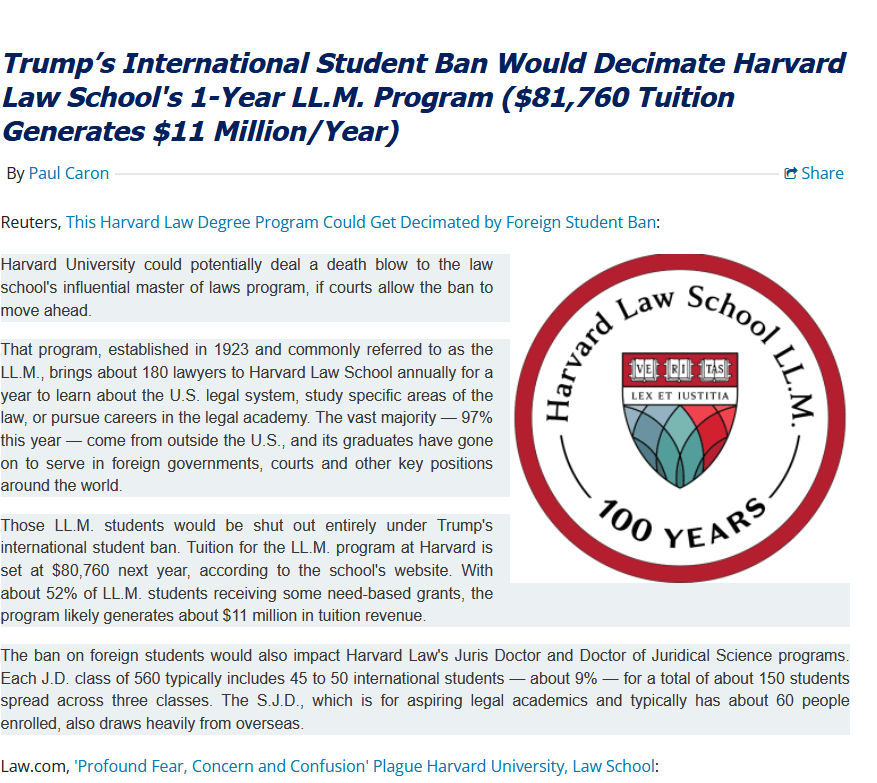
So when I saw the headline yesterday, Trump’s International Student Ban Would Decimate Harvard Law School’s 1-Year LL.M. Program ($81,760 Tuition Generates $11 Million/Year). Having spent the last ~5 years openly discussing the business of LL.M. programs, I knew my day would be busy.
While the article was about Harvard, it drew attention to a topic that will likely expand more broadly (other law school LL.M. programs) and deeper (other degree programs at U.S. law schools and in higher education).
The Business of Non-J.D. Operations & Residential, International Students
I had already posted my blog entry on the Harvard news and my new ECUPL students before I saw the Harvard story. But I added a post on my personal LinkedIn after:
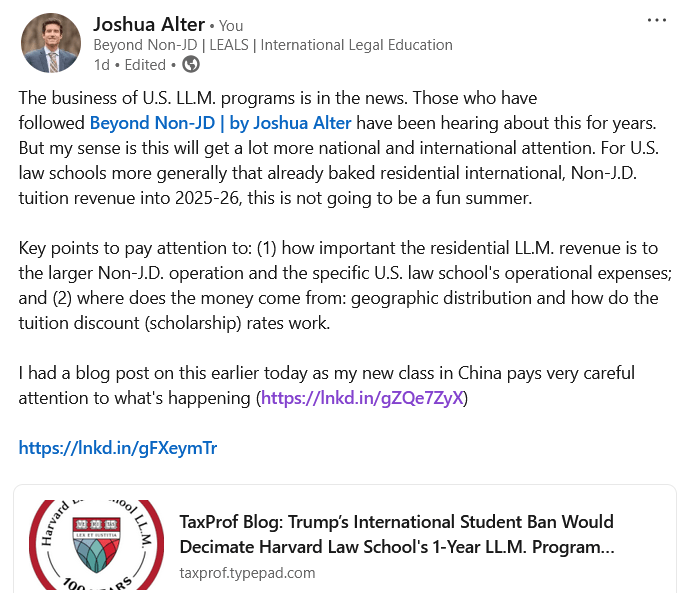
Just like my other blog post today about using COVID-era information as a guide to the February 2025 California Bar Exam, I think there is an important point here.
COVID was a jolt to U.S. law schools that relying exclusively on international, residential LL.M. tuition (and any F-1 revenue) assumes the ability for those students to get to the United States. Luckily in 2020, bar exams that allowed eligibility through LL.M. studies gave waivers and schools went hybrid. And so some students chose to study in U.S. LL.M. programs from abroad, saving the money on a one-year move and securing the credential.
Although schools had already been growing other revenue streams in the online degree, non-degree, and U.S. audience (e.g., M.S.L.) spaces, this was a wakeup call to those who were still lagging. If your Non-J.D. revenue depends on F-1 students, you are at the mercy of them getting to the United States.
And so an actual visa ban or even just messaging about one sends a message to international students. As they decide on these time-intensive and expensive degrees, will the ROI be there, at least in the immediate post-LL.M. experience?
For many who reach out to me, that is a combination of (1) obtaining a law license in the U.S. and/or (2) using that license to earn USD by working through OPT. And so, unless state courts and boards of law examiners channel the togetherness of 2020, potential F-1 students may have to make an important calculation weeks before the LL.M. year begins. Risk changes to OPT? Risk issues with a visa that can affect Character & Fitness determinations or even the ability to be in the U.S. to take a bar exam?
Most At Risk? But Why I Think, On Balance, This is a Good Thing
As noted in the LinkedIn post, Non-J.D. operations, school financial situations, and other factors make it difficult to make broad generalizations across U.S. law schools. But I do think that schools that rely heavily on F-1 international residential LL.M. tuition may be in a bit of trouble this Summer.
But overall, I think it is important for us to have discussions about the role of residential international LL.M. students in U.S. law schools. And attention being drawn to Harvard likely means a lot more people are going to be paying attention to these students, reviewing programs, asking questions, and doing much more.
Will this lead to more resources for international LL.M. students? A deeper dive into the J.D./Non-J.D. distinction? The business and ethics of Non-J.D. programs? Possibly.
I’ll have more on that as the Summer plays out, especially as I speak with colleagues, former students, and others in China who are carefully watching the visa news and waitlist movement.
 Beyond Non-JD | by Joshua Alter
Leave a comment