
From China and “Regular” LL.M.s to Latin America and Tax LL.M.s
I “fell into” LL.M. recruitment, something I wrote about years ago. It was not something I was hired to do, and St. John’s didn’t even ask me to do it early in my career.
And I think it is far more likely I’d still be at St. John’s had I not had my amazing China experience. But it did mean that at least one exit option that would have been less likely for me as a student services/LL.M. legal writing person opened up once I repatriated.
But University of Florida was quite different from St. John’s. Unlike many other law schools in the U.S. with big LL.M. programs, China was not a major source country for UF Law LL.M. students. And unlike schools with very big General LL.M. programs populated by foreign-educated students, UF’s focus was its nationally and internationally recognized Graduate Tax program. Where most students are from the U.S. or have a U.S. J.D. already.
Career wise, it was the best thing I could have done. I had to cut my teeth in a very different work environment. Working where you went to law school, for your favorite professors, is not a typical first job in higher education!
But I also had to prove I wasn’t just “the China guy,” or someone who could get LL.B. students in their early 20s excited to study in New York City through partnerships. And so I leaned on amazing alumni, great students, a Florida statute focused on Latin America and the Caribbean, and a very supportive group of faculty and administrators.
And all three of my international trips for UF in my first year, 2019-20, were to South America (first Brazil in November 2019, then Chile and Colombia in December 2019, and then Peru and Ecuador in February 2020.
A Great Law School for Latin American Tax Lawyers!
In February 2020, I was in Quito, Ecuador, as part of my UF Law travels. As the world was starting to learn about COVID-19, I was having coffee with Dayana Naranjo, one of the last prospective LL.M. students I met in person before 2023.

Dayana, like others who spoke with me, had questions as she was finalizing her plans. As it became clear 2020-21 would not be a “normal” year, Dayana made the decision to defer. She still went to UF Law a few years later (even after I left!), and has had a great post-LL.M. career in the U.S. and U.K., and we’re still in touch. And is a proud Global Tax Gator!
After I posted a shorter version of this story on LinkedIn, Dayana shared some follow-up thoughts. And I am so glad she did, which reinforced the message of that LinkedIn post.

I don’t think 2025-26 will be a “normal” year either. But general advice on “everyone should defer/go somewhere else” or “everyone should still come” this year is unhelpful.
What are your goals? Are you coming on an F-1 or are you a green card holder/U.S. citizen? Are you getting a very large scholarship or no scholarship? What school are you planning to attend? Do you have a great job right now or are you at the beginning of your career or in a transition phase?
And as much as I hate to say this, are you someone who is likely to have a smooth year or are your interests, career experiences, and social media history likely to put you in an unwanted spotlight? How much do U.S. law and politics matter to you as you think about your LL.M., bar exam, job prospects, etc.?
Will every corporate lawyer doing a General LL.M. for the New York Bar have a smooth year and every International Human Rights LL.M. have a bad year? I doubt it. Life, circumstances, and even luck are too variable for one-size fits all guidance on almost anything. Let alone these major career and financial decisions.
Get Good Advice!
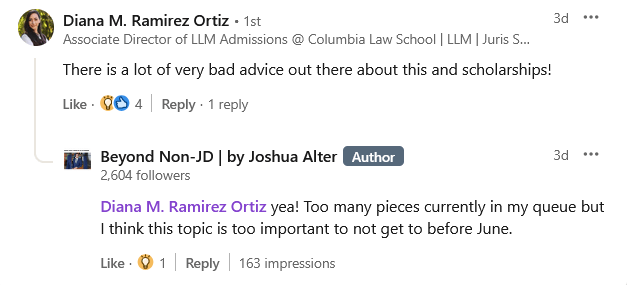
I always enjoy seeing notifications from Diana Ramirez Ortiz (you may remember her from my International Jurist piece on exchanges). I know that my readers will get balanced and helpful advice from inside higher education. Which is important, especially now that I’m on the outside.
On a LinkedIn post on the complexities of LL.M. waitlists, she noted something that I think also applies in the context of deferring/reapplying.
When I worked for U.S. law schools, my philosophy was that happy LL.M. students would make my work easier/better/more fulfilling. Timing LL.M. degrees is something many of you have seen me write about (and that I spoke with Maricela Muñoz about on her podcast), as I do about maximizing your LL.M. year and making the LL.M. work for you.
And I think (or at least hope that!) the LL.M. prospects I have met sensed that authenticity. It also helped that I spent the last 5 years (at the time, now 10), teaching students who chose different U.S. law schools and different jurisdictions for their degrees. There was never a “hard sell,” because that would have meant a greater risk of a bad experience. Why put myself through that? It’s not like I made more money if more LL.M. students came to my school (if I was paid on commission I probably would have retired after 2018!).
And so I agree with Diana! Who is giving you the advice? What experience do they have with the LL.M. experience, with what’s currently happening in the U.S., with what your goals are? There is a difference between going through an LL.M. degree as a student and seeing “behind the curtain” from inside higher education.
What are the incentives of the person who is giving you advice? To take what I hope is a silly hypothetical thought experiment: would you automatically take advice from someone on the Waitlist at your dream school to turn them down and go somewhere else? Especially knowing they really want to go there and would happily take your spot?
Turning that offer down (edited) may make sense for you in that scenario. But you’d at least question the motivations. It is important to get expert advice. But also balanced advice. And customized advice.
And before a cynical comment about U.S. LL.M. people not being able to ever give you neutral advice? I would like to hope people who worked with me from 2015-2025 would say that I gave great advice from inside higher education. There are too many people who spoke with me who chose other schools, other jurisdictions, or not to study abroad, for my career to be viewed as a salesman for the schools I worked at.
And a deferral is not a “goodbye forever.” Unlike choosing somewhere else, deferral just means, “I’m still interested, just do not think this is the best year for me.” We deal with deferrals for financial reasons, for life events, for health issues, and for so many other reasons like a global pandemic. A deferral for 2026-27, unlike reapplying, is at least a minimal commitment that you still plan to attend that school the next year.
And as much as I’d like to think I’m special, I think there are other people inside higher education who have the interest and ability to give balanced advice to LL.M. prospects. Part of it is our connection to LL.M. programs and LL.M. students. But part of it is sadly the different financial situations at different U.S. law schools and how much pressure LL.M. admissions teams/LL.M. offices are under to deliver.
As a very basic, general observation (exceptions apply both ways and I do not know all!): Smaller LL.M. programs at more prestigious schools often seem to provide that opportunity. As do recent LL.M. grads who work for U.S. LL.M. programs and really want to help students know more than they did. As do schools where, for various reasons, there is not pressure on the LL.M. office to “deliver.”
Let’s Wrap This! Concluding Thoughts on Deferring or Reapplying
Will 2025-26 be a great year for you to do a U.S. LL.M.? A terrible year? Similar to what would have happened in 2024-25 or 2026-27? It’s hard to tell.
And so if 2025-26 is still a great year for you to study in the U.S.? Ignore the noise. Start finalizing your plans and prepare to maximize this special opportunity.
And if it’s not? Ultimately it’s your career and your money and your life.
But I am relatively confident that U.S. law school LL.M. programs will still be around in 2026-27. Like that coffee meeting in Quito with Dayana, it sometimes just takes someone with a longer-term perspective to give you that guidance you need.
 Beyond Non-JD | by Joshua Alter
Leave a comment