I owe my career to LL.M. students, LL.M. programs, and the ABA’s J.D./Non-J.D. distinction. None of this is a secret. I’ve readily acknowledged this throughout my career, and from inside higher education. I owe my career as much to the Saudi Arabian Cultural Mission, Chinese students & their families who invested in U.S. law school education, and a Florida statute that welcomed Latin American and Caribbean students, as I do to amazing mentors and a little bit (okay a lot) of luck.
My butterfly effect? Four LL.M. students from another school transferred to my J.D. school during my 3L. I was in the right place at the right time, as a 3L TA, when my school needed someone to teach them LL.M. Legal Writing II the semester after I graduated.
Revenue Generating Programs Can Also Be High-Quality Programs. These Two Things Do Not Have to Be Mutually Exclusive.
Non-J.D. programs are designed to make money. I also very openly believe U.S. law schools can make (a lot of) money from their Non-J.D. operations and create and offer amazing programs, opportunities, and experiences. I do not believe they are mutually exclusive. And I have seen that in action, in my own career, from my LEALSers experiences across the United States, and from seeing the work of some of my most cherished colleagues.
While I do not get overly rosy or optimistic, I try to equally avoid being overly cynical and pessimistic. No, LL.M. programs aren’t “scams.” I have worked with enough foreign-educated lawyers whose careers and lives changed thanks to LL.M. degrees and opportunities to come to the U.S. to study.
Origin Stories Can be a Tricky Thing.
How much of an origin story is true and how much is creative storytelling? How much can I really remember from my 3L year, from my move to China, or from my first career jump? Especially years later.
I am glad I wrote down some of those thoughts years ago (the five-part series starts here), which I still look back on fondly.
My Beyond Non-JD origin story is a little hazier, 4.5 years later. I do not recall the exact moment I created the WordPress site or fired up the first blog entry (below).
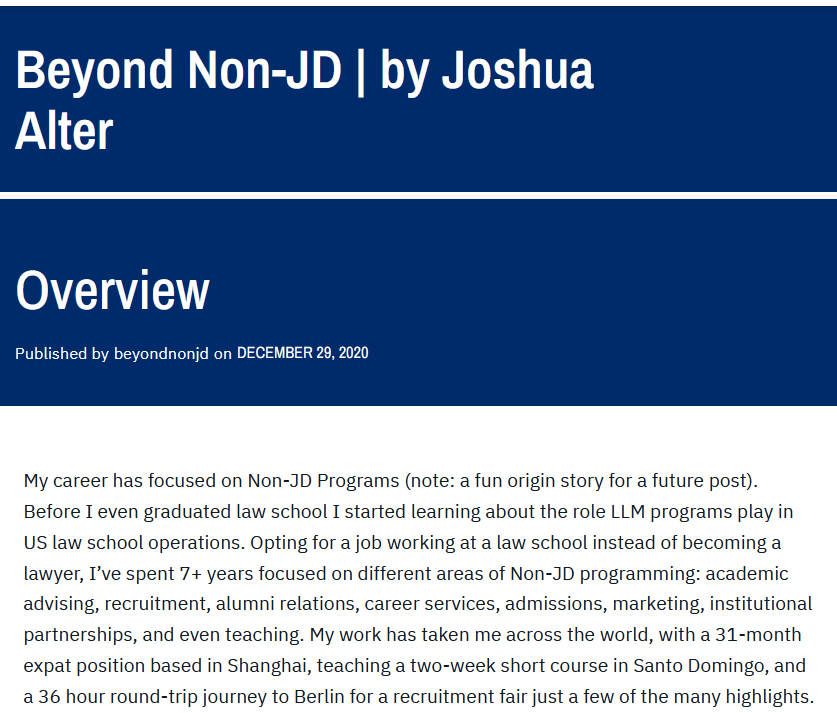
But I am glad I started the blog, creating a space and community to discuss international LL.M. students, international LL.M. programs, and the business of U.S. legal education for foreign-educated lawyers and law school graduates. Even if only a couple people saw it at the time. It’s crazy to wake up today to see the LinkedIn page is up to 2,600 followers!
I spoke about bar exams, jobs, scholarships, and other things that were part of the “hidden” LL.M. information-gathering process. And I started to really focus on sharing the same free, balanced, and expert advice that anyone who e-mailed me or called me up or met me had access to.
Beyond Non-JD 2.0: What’s Changing and What’s Not.
I didn’t wait until I was outside U.S. legal education to talk openly about important issues. Costs, information, opportunities, the evergreen comparisons to J.D. programs.
I get why these conversations may make people whose jobs depend on LL.M. programs bringing in enough revenue uncomfortable. My honest hope, as it has been since I started the blog, is that these resources and conversations help ensure that LL.M. programs are populated with students who are good fits for LL.M. programs. And have similar happiness/satisfaction rates to J.D. programs.
I truly think that more informed LL.M.s make for happier LL.M.s. And that public spotlights on LL.M. programs and the students in them make schools more receptive to spending more resources on LL.M. students. I think LL.M. programs need an outside champion as their schools have to make difficult choices. And I’ve been more than happy to be that advocate. Having trouble getting your school to commit more resources to LL.M. bar exam support or scholarships or CPT support? I hope my articles have been helpful to show why these matter.
And so the themes and goals will remain the same. I have no plans to change, in any way, how I talk about these programs. Nuanced, thorough, and always aspiring to be just a little bit better than the year before. Sure, some people will take offense that I’m discussing them publicly.
Given 4.5 years of posts and articles, I’ll move away from many of the themes that I’ve already covered extensively. And given the amazing new voices in the LL.M. world, I do not have to spend as much time talking about the student experience. It is far better to hear directly from LL.M. graduates and LL.M. students, to hear their perspectives and insights.
You’ll also notice a lot less posting on the LinkedIn page (which may be a good thing for some!). I’ll still be active on social media (mostly Instagram, RedNote, and my personal LinkedIn). But as I shift into more teaching and more consulting, I’ll try to be more efficient with my time and my posts.
The way to get in touch: schedule an appointment. I’ll have more extensive packages up in June, but for now, the one-off meetings are available. Whether you want some advice before you make your final decision, you want to get a head start on the 2025-26 cycle, or you want someone to give you neutral, balanced, expert opinion, I love that I’ll keep getting to do what I’ve done for years.
But free information will remain a key component of my work. So please be sure to follow the Fee Waiver newsletter to get information aggregated biweekly. Next one out on May 30! I’ll blog more (so be sure to subscribe toward the bottom of the main WordPress homepage). And I’m excited to renew my partnership with The International Jurist for 2025-26. I’ll write 6 articles and am proud that our work together will extend into a fourth year.
And I have taken the feedback and advice to heart that I should go into consulting to help more people. I was asked to help with current LL.M. students as much as LL.M. prospects. I was asked to create LEALS courses that are open to the public, rather than just through my university partnerships. And I’m always open to feedback to make Beyond Non-JD even better.
Because ultimately, my goal is for law schools to look Beyond “Non-J.D.” when we think about, recruit, discuss, and welcome international LL.M. students.
– Josh
 Beyond Non-JD | by Joshua Alter
Leave a comment