Foreign-educated LL.M. graduation posts are a big highlight for me each year. Completing law studies in a new country, often in a second language, is a big accomplishment.
But for plenty of residential, foreign-educated LL.M. graduates, the next few months are viewed as make-or-break for how they will look back on the LL.M. experience.
Coming up: the stress and added costs of preparing for a state bar exam. And for some F-1 graduates (the primary audience for this post), the uncertainty and stress of the post-LL.M. OPT job search.
The most important thing I can say if this is where you finish reading? You are not alone and this is something that happens more often than you may think.
It is not surprising that you won’t see as much about this on social media. LinkedIn is for our professional Ws, right? But towards the end I’ll share a couple strategies to think about.
No Bundle Packages.
We can say that the LL.M. is not a bundle package with a law license and a (good) job in the United States as much as we want. I say it all the time. And NYU has the best website to explain the realities of the U.S. job market for foreign-educated LL.M. students that I have ever seen!
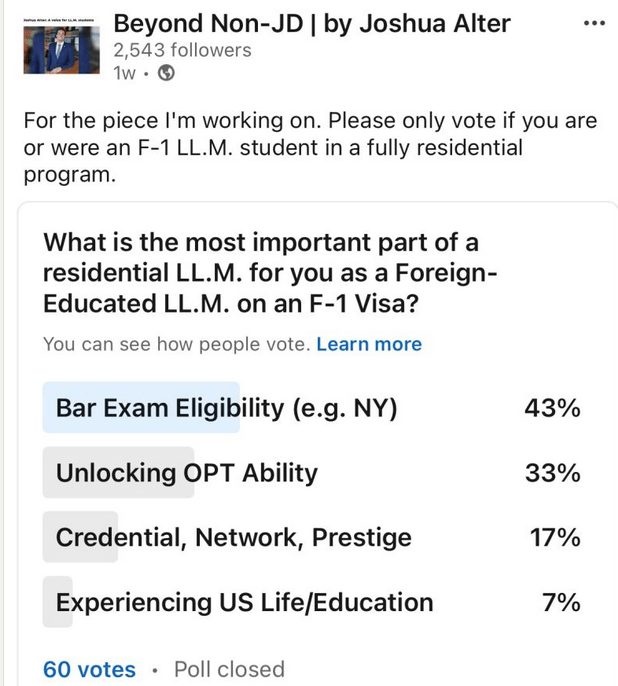
But overall, we know that many foreign-educated LL.M. students are enrolling for one or both of these reasons. Go to any LL.M. presentation, pitch, or fair and you’ll hear questions about both. LL.M. webinars and presentations often cover both, from eligibility to the New York Bar Exam to the OPT resources and support LL.M. teams have for their students.
Don’t believe me? Here’s a recent Beyond Non-JD poll:
The Challenge & a Key LL.M. Tension
LL.M. programs can do an amazing job with the education, the experience, the credential, the alumni network, and other related things.
But LL.M. programs cannot take the bar exam for you or hand you a great job in the U.S. (trust me, I wish I could)!.
Remember, there are a number of J.D. graduates who fail bar exams and are unable to secure legal jobs every year. Especially at a certain subset of low-performing U.S. law schools. You can check the ABA Required Disclosures and popular websites to see more about those.
While a small number of LL.M. programs have the luxury of restricting admissions to those most likely to be successful on one or both of those fronts (or who are not interested in either bar exams or U.S. jobs), the realities from how J.D. and Non-J.D. programs are structured under the ABA make that hard for most U.S. law schools.
Summer Struggles for Some?
Some LL.M. graduates are preparing to return to great jobs abroad. Others to start exciting new chapters thanks in part to their U.S. LL.M. degrees. Others have already finalized great positions in the U.S., including visiting foreign associate positions, great Tax LL.M. jobs, and other awesome post-LL.M. positions that are better than plenty of J.D. grads in the U.S. secure!
But for some (many?) LL.M. students, the Summer is now a struggle to balance preparing for an expensive add-on for a state bar exam and navigating the uncertainty of the post-LL.M. job search. Especially if on a student visa under the current OPT/H-1B climate.
Scrolling on LinkedIn, you may second-guess your LL.M. experience.
But is all hope lost? I hope not!
The Plan: Keep Moving Forward & Use Your Networks
If you are still looking for a job and focused on bar prep, what can you realistically do? Especially if you are on an F-1 visa and your OPT clock is starting to tick (yes, U.S. citizens and green card holders can wait longer and apply to more positions, which is an unfortunate reality).
- Focus on the one you have more control over. For most F-1 students, the bar exam is likely the one you have more control over. You don’t have to rely on the economy, interest in LL.M. candidates, or navigating OPT. You’ll take that exam in two months alongside J.D. grads. And you are probably spending thousands of extra dollars to take that exam. The bar exam prep experience is exhausting, even for J.D. grads. OPT jobs may want you to be a licensed attorney in a U.S. jurisdiction, and so doing your best to pass that exam is an important step 1. You’ll need to balance both, but it helps to know which to put more emotional energy into.
- Have a realistic Plan B and Plan C. Students I’ve worked with are familiar with my Plan A/Plan B/Plan C work throughout their LL.M. experiences (and even before they started in my Pre-LL.M. programs). If your OPT clock winds down, do you have something lined up? Another degree? A job abroad? Another plan? It can be scary and feel self-defeating to think about not securing a job in the United States. But you will not have the same luxury as U.S. citizens and green card holders.
- Lean on Your Law School Networks and Other Networks. If you have been “networking” throughout the year, this one is much easier than if you’re devoting attention to it for the first time now. All those coffee chats and virtual meetings and informational interviews should ideally have created a network of people who want to see you successful. While your law school cannot hand you a job usually, who in your network is willing to take a chance on you or champion you in front of the right people. That is more often than not going to come through your Pre-LL.M. existing network or the people you’ve met during your LL.M. experience.
- Realistic Assessment of Your Situation. If you are looking for entry-level positions, how do your credentials stack up to J.D.s and other LL.M.s competing with you? Again, not every J.D. grad secures legal work after the three-year degree. The U.S. may have an access to justice gap, but we are not short of law graduates. Are you able to work in a low-paying job just to stick around for OPT? Or do your earning needs to stay in the U.S. have to be at a level that certain jobs that some LL.M. grads take are off limits to you.
- Be visible. People can help you if they know you need help. How can you get yourself out there for positions? The green badge of Open to Work? A long post on LinkedIn? This is where I’d recommend speaking with trusted people in your network about the art of being visible. Too negative a post may create backlash that causes you more problems than they’re worth. Too hedging of a post may mean that someone who could have helped you missed your need. There’s a real art to this, and hopefully either your LL.M. career advisor or someone else you know well is willing to be a sounding board for you.
Conclusion
Students I’ve worked with have heard me say that I 100% acknowledge that I will never have to face an OPT clock.
Would I have had the same post-J.D. career if I had come on an F-1 visa as an international J.D. student? I honestly doubt it.
The stakes are so high for the next two months for so many international LL.M. grads. I hope you can enjoy the highs of the graduation celebration with friends and family. And then shift to a laser-like focus on the next steps.
If you’re in that bar exam & job search limbo area, I hope you have great resources, networks, and support systems for the next 2-5 months.
And that I’ll have the opportunity to see great news from you soon!
 Beyond Non-JD | by Joshua Alter
Leave a comment