The Georgia Board of Bar Examiners released stats from the February 2025 Bar Exam yesterday. I’ve already written about Georgia’s leadership on Beyond Non-JD and for the International Jurist. To avoid repeating too much, you may want to review those pieces first.
February 2025 Results
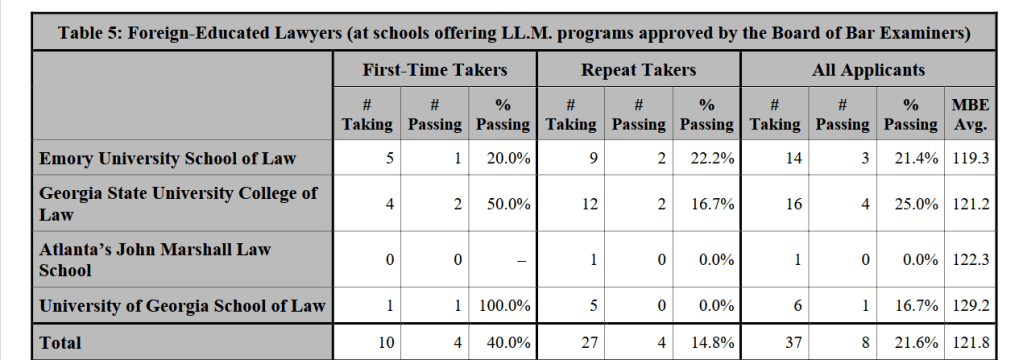
Table 5 is the first place I go when I see Georgia stats releases. And that is because Georgia is the only State I’m aware of that breaks out LL.M. pass rates by school. Georgia also shares the MBE average at each school.
Background Information: States and Foreign-Educated Bar Exam Takers
Each State can choose how easy or difficult is is for foreign-educated lawyers to sit for their bar exam without an ABA-accredited J.D. degree.
Some States, like California, make it very easy. Attorney abroad in good standing? You should be good to go without an LL.M. degree.
Some States, like New York, make it very easy for common law educated graduates who meet durational and substantial equivalences.
Others, make it relatively straightforward with a General LL.M. degree from the U.S., so long as certain curricular requirements are met. For civil law educated graduates? New York, Texas, Washington and a few other States are popular.
Others make it impossible. Or at least very challenging.
Georgia
Georgia strikes a great balance, in my opinion. You can look over their requirements here. Georgia’s requirements are extensive, but fair. They focus on Georgia specifically and the preparation for people to practice in the State. Their requirements make it unlikely (though obviously not impossible) that students who study at law schools outside Georgia will take the exam. And from what I’ve seen on the stats in recent years, it appears to be only Georgia schools in Table 5.
The goal seems to not be to get as many takers as possible from across U.S. LL.M. programs. Rather, at least from what I can see on the outside, it appears to be a focus on preparing foreign-educated law grads to practice in Georgia after 1/3 the amount of time as J.D. grads.
Could Georgia be even more strict and still allow a direct route? Of course. Could they be more lax, like New York or even California? Sure.
But I think they strike a good balance.
And the reason we get stats? Check out #7:
- A law school must publicly disclose on its website the first-time bar passage rates by state of its most recent class of graduates of an LL.M. programs specially designed to comply with these Curricular Criteria and to prepare students for the practice of law in the United States
Back to What We Can Learn (and what we cannot)
I started off with three caveats that I think are important.
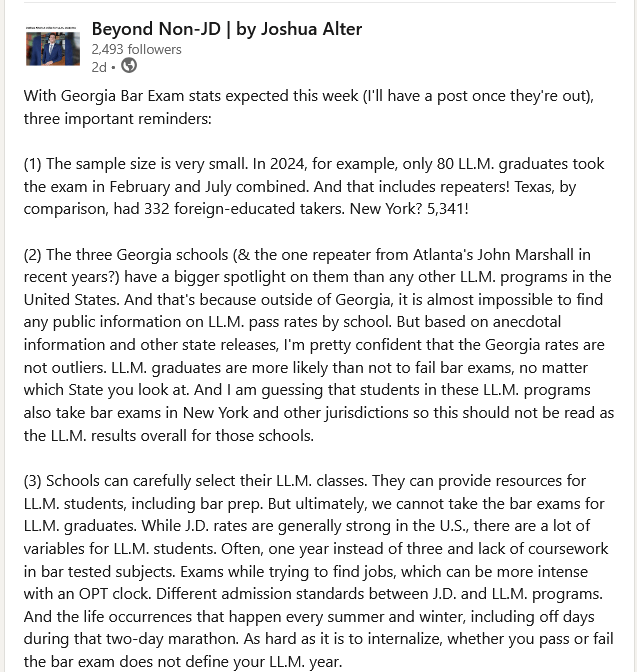
When the numbers are so small, it is hard to truly read too much into pass rates. The difference between a 100% and 0% pass rate can literally be one person. So instead of looking at an individual school for an individual year, I try to look big picture. Or at least as big as possible.
The Georgia schools are on display here for their Georgia pass rates. But plenty of LL.M. students choose schools across the U.S. with an eye towards the New York Bar Exam. Georgia’s state schools offer affordable tuition options, Atlanta is a popular city, and so we don’t see how LL.M. students who chose a different jurisdiction fared. Weak Georgia rates but great New York rates, or vice versa, don’t tell the full story.
And finally, the purpose of an LL.M. is often debated. Is it designed to pass a bar exam? Tricky and loaded question. The language from Georgia makes it seem, again to me, that students who enroll in these programs specifically to take the Georgia Bar Exam are attending, in part, to pass. And that Georgia is offering them some of the same protections and support J.D. students across America get.
So How Does Georgia Help? And How Does it Not?
Understanding the Georgia stats is straightforward in some ways. But you have to understand a lot about LL.M. programs, LL.M. admissions, LL.M. resources and support, and quite a few other things to understand Georgia’s stats more broadly. Some points worthy of more focus:
- What is the real difference in pass rates between LL.M. students from civil law jurisdictions and foreign-educated lawyers from common law jurisdictions who do not need an LL.M. to qualify. When New York lumps both groups together, my gut tells me there is a gap. I just don’t know how big it is.
- Do the Georgia schools put more emphasis on LL.M. bar exam support because of this public information? Schools have to ensure J.D. numbers are higher for regulatory compliance. But in marketing, schools do highlight J.D. pass rates (Florida is a great example, especially with FIU versus the more traditional and established top Florida schools). And for someone who just wants a bar license, how do you make a decision between Georgia (where you go to school, where alumni bases are stronger, where you can network all year) versus New York (largest legal market). Especially for F-1 students who may need to work abroad after the OPT year and are thinking about bar licenses for more cross-border business work.
- How are prospective LL.M. students using this information? The ABA Required Disclosures are still underutilized in my opinion by J.D. prospects. Because these numbers are so small, how do LL.M. prospects use them. Does someone from a civil law jurisdiction with an 85 TOEFL who failed tell you if you’ll pass with a 115 TOEFL? Does someone who wasn’t able to devote the whole summer to studying because of a job search and life circumstances tell you if you’ll pass spending all year studying with the highest-priced bar prep company and a coach?
- How likely are other States to adopt something similar. Knowing the actual LL.M. bar pass rates may hurt the pockets of the jurisdictions that administer the exams and schools that recruit a lot of LL.M.s with an eye towards a bar exam? Georgia is unique in that schools are required by the board to share this information and the board shares it as well.
 Beyond Non-JD | by Joshua Alter
Leave a comment