I just wrote my first cover letter since 2019 (more on that in a couple weeks, possibly!). Since I spent a lot of time working on cover letters with foreign-educated LL.M. students, I wanted to share some tips for those starting their LL.M. programs this month. Your school will hopefully cover what they are and how to effectively use them in a lot more detail. Be sure to work closely with your LL.M. program to build the best application documents (including a cover letter) that you can!
- Networking Before Cover Letters
There will be many job postings that you can apply to “cold” (by this I mean without any direct connection). However, I encouraged my students to speak with at least one person at the company/law firm before applying. This helped in multiple ways, including having information to include in the cover letter. But equally (or more) important was that it built a personal connection at the organization. Rather than being just another application in the pile, students who left a strong impression in their networking may have that person share their application when they applied, or let colleagues know to look out for an applicant.
2. Figure Out if You Need a Cover Letter
Reading application instructions is crucial. Some lawyers told me that they first only wanted to see the resume. Some lawyers told me that the cover letter was the first thing they read. And many fall somewhere in between. Demonstrating that you read the job posting carefully is a positive and demonstrates attention to detail. When in doubt, you can reach out to the recruiter/organization. And if you do need one, ensure that it adds to your overall application.
3. A Cover Letter is Not an Essay Version of Your Resume
Every position I’ve seen asks for a resume. One of the mistakes I occasionally see is a student writing their resume in essay format. “Here’s where I go to school, here’s what I’ve accomplished, here’s what I’m interested in.” The employer already has your resume, and so a second version of your resume does not add to your application. My suggestion for students I work with is to think about the cover letter in one (or more!) of three ways: (i) how does the cover letter explain the motivations behind your resume; (ii) how does the cover letter add important information that the employer would not have otherwise known; and (iii) how does the cover letter explain how the candidate would be a good fit for our organization.
4. Personalized Without Hand-Crafted
In most situations, I think a unique cover letter for every single position is an ineffective use of time (though for a specific position it may make sense). The advice I share is to get across the line from “this is a cover letter that went to everyone” to “this candidate is clearly interested in our position.” Early in the year, I’d work with students on personalized paragraphs that could apply more broadly based on backgrounds, preferences, and conversations. That way, they could easily focus their personalization on something unique about that specific employer, without writing a new cover letter for each position.
5. Mistakes Happen
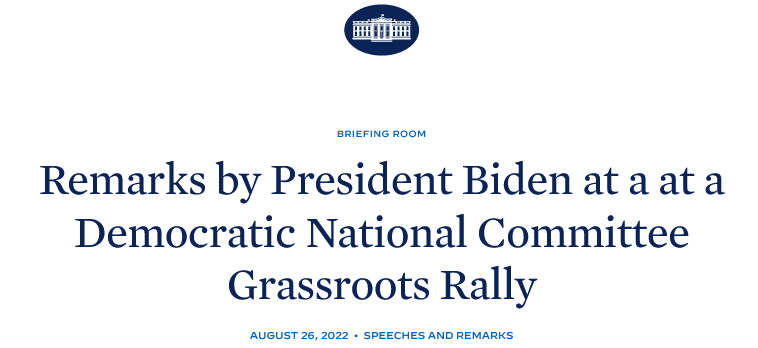
We obviously want to aim for excellence in our cover letters. But mistakes can and do happen (see below for an example from the White House on Friday). Cover letters and resumes are often held to a standard of perfection. If you do make a mistake, you may still get the interview. You may not. But don’t let one typo or error harm your other applications. Move on and you may even be surprised!
6. Play the Long Game
The cover letter is unlikely to get you the job (if it does, reach out to give me tips!), but understanding the role that it plays is important. A strong cover letter may get you a screener because a company is interested in your background or something in particular that jumped out in the cover letter. In a longer interview, the people interviewing you may have each read your cover letter and will want to discuss parts of your cover letter with you in your interview. One of the things I loved seeing in 2019: when people had my cover letter printed out with topics they wanted to chat about. I knew that something I wrote resonated with that person and was ready to discuss that part in more detail.
 Beyond Non-JD | by Joshua Alter
Leave a comment