In February 2018, I visited Nepal for a regional forum hosted by EducationUSA. My highlight was presenting, with a U.S. law school colleague, to a group of EducationUSA advisers. We focused on the things we thought would be most helpful for the advisers as they spoke with students interested in pursuing legal education in the United States. I was really happy with the turnout given how relatively small law demand is compared to undergrad, STEM, business, and other majors. After the panel I was able to spend time answering a lot of questions about U.S. legal education, and followed up with a number of the teams from around South and Central Asia after the event. That event also made it much easier for me to visit India, knowing that great EducationUSA teams were in place to offer guidance and specialized knowledge.
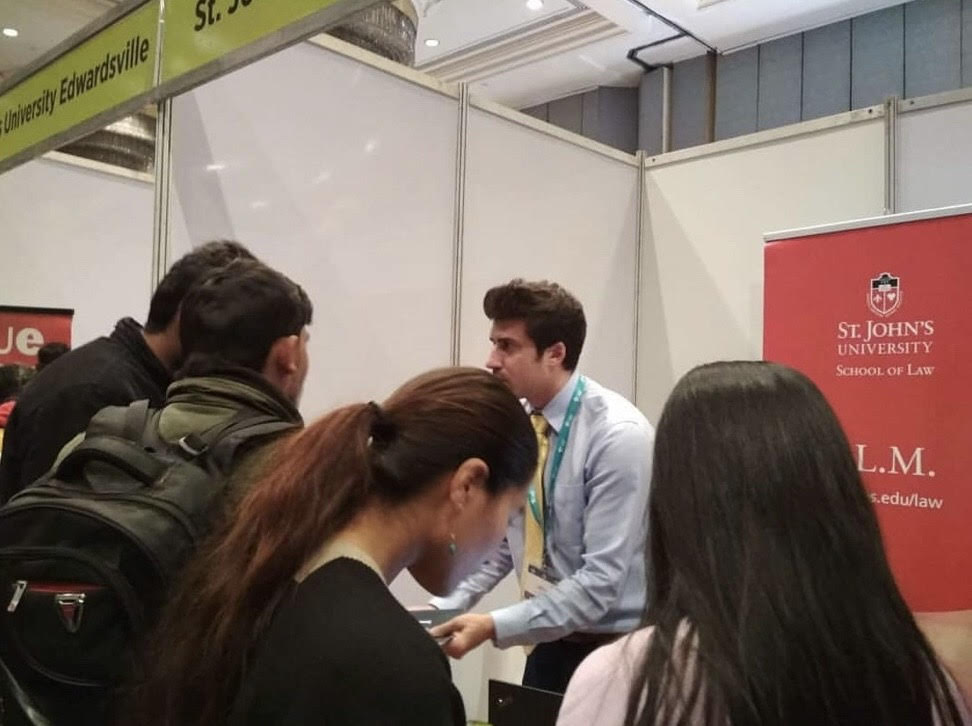
Having spent Thursday and Friday at my first in-person conference since February 2020, the notification that I was in Kathmandu on this day in 2018 was a nice reminder of pre-pandemic recruitment. As U.S. law schools begin to think about heavy in-person international recruitment, possibly as early as Fall 2022, I had some thoughts for U.S. law schools and international students.
U.S. Law Schools
- I think it’s going to be hard to justify international travel costs that don’t have a significant ROI at a lot of law schools. The idea of visiting a country or region to explore a market or begin building connections will be a tough ask of deans. I think schools that are trying to build programs (as opposed to well-established brands) will really make-or-break based on their pre-travel engagement. That’s a longer topic, but in short, what are you doing before you land to ensure that you’re meeting the right people.
- Pre-pandemic and move to Florida, I thought about modeling international recruitment and engagement on airline flight models. I thought law schools trying to build programs would benefit from regional hubs that they build their activities from. My advice: choose a major city in each region you’re planning to work in and build from there.
- Work with your main universities. It’s often hard to keep track of what law school faculty, staff, students, and alumni are up to in countries you want to recruit, let alone what’s happening across your campus. Universities that have great communication across departments will allow you to maximize your networks in countries you’re visiting, can save you trying to find partner institutions, and may allow pooling resources for events on-site.
International Students
- You should use the lead up to forums, fairs, and recruitment events to learn about the main general points for U.S. legal education. To me, that’s: (i) the differences between J.D. and LL.M. degrees; (ii) the general overview of sitting for state bar exams in the U.S., (iii) how working in the U.S. as a law student (CPT) and after graduation (OPT) work and the types of jobs available to foreign-educated and international law students; and (iv) how rankings and funding generally work for J.D. and LL.M. programs. Once you know those four areas, you get to spend more time talking to U.S. law schools about their specific programs and your specific goals. E.g., “what opportunity would I have to work in an internship as an LL.M. student at your school” or “what resources do you offer for international students in your J.D. program to assist with the post-grad job search”
- I recommend working with your law school (if you have a legal education background) to see which schools are visiting and what opportunities there are for partnerships between your university and a U.S. university. These can be the most cost-effective way to attend a U.S. law school for a semester or possibly a year (e.g., an exchange), allow for built in scholarships through MOUs, and possibly lead to dual/joint programs (depending on the market and interest). U.S. law schools new to a region may be highly interested in such a visit in addition to the recruitment fair they’re attending.
- Don’t wait until you begin a U.S. legal education program to start your journey. A number of U.S. law schools are now offering summer/online immersion courses. These and other opportunities may assist you as you evaluate your options, study for the LSAT (for J.D. programs), go through the application process, and network in-country before arriving in the United States if you are looking to work post-grad. There are a number of great free and paid resources available and a recruitment event may be an important first step in understanding what you can do in the months between applying to U.S. law schools and attending one.
 Beyond Non-JD | by Joshua Alter
Leave a comment