Pre-pandemic, bilateral partnerships were a foundation for LL.M. growth. Especially for schools without a deep-established international presence, bilateral partnerships offered a way to internationalize and welcome cohorts of LL.M. students. Schools varied in what the partnerships offered, but during my time in China I was able to see a variety of models. How will bilateral partnerships evolve? How has the pandemic changed the nature of these agreements? And what should law schools outside the U.S. that are relatively new to bilateral partnerships be thinking about?
Partnership Benefits
If you check U.S. law school websites, you’ll be able to see pages listing global partners. There are a variety of options when you’re setting up a partnership with a law school in another country, and reviewing some of the more prominent pages will give you an idea of which countries/universities abroad are the most active. Some of the benefits may include:
- Inbound Mobility: American law schools can offer large scholarships to students from the partner school who choose to attend their LL.M. programs. This allows a student to use a discounted cost rather than the listed tuition when factoring whether to attend a certain school. Students also know that they won’t be going to the school in the U.S. alone and that they have the strength of their school partnership behind them to support them.
- Outbound mobility: American law school students can study abroad at the partner, either for a semester through an exchange or in some very cool cases, in a 2+1 where they spend their 3rd year at the school abroad and also get an LL.M. degree!
- Faculty exchanges: If structured appropriately, you may be able to have a U.S. law school professor teach a course at the partner school and have a professor from that school teach a course at the American law school. This can work particularly well for inter-session or short courses.
- Joint/Dual Programs: Schools can design specialized 1+1 or even .5+.5 degrees where students spend a year or semester at both schools and receive joint or dual degrees.
- Hub Abroad: When both schools are offering travel programs in the other country, they may use the partnership as a hub for their activities. For example, if your school is offering a travel course in that country, you may visit the school as part of your trip and connect with them for advice and logistics.
- Internationalization: We live in an interconnected world and global lawyering is a popular topic. Partnerships can signal a commitment to internationalization.
Evolution and the Pandemic
Before the pandemic, facetime was an important component of partnerships. In fact, I built the second stage of my career around this concept by being based at select partner schools to teach Legal English for American Law Schools! Visibility was an important component of partnerships and it was not uncommon to see other law schools visiting partners throughout China, mostly in September/October and March/April. Likewise, delegations of partners often visited America and visited the schools they worked with for meetings, to check in on students currently studying there, and to interact with faculty.
In March 2020, we all stopped traveling. While we had to first focus on the pandemic, we slowly began to re-engage partners virtually. With most mobility shut down for Fall 2020 and some even into Spring 2021, the main focus of many partnerships was halted temporarily. Students couldn’t study in the other country, symposiums that were planned or being thought about wouldn’t be taking place, and faculty and administrators would not be traveling to meet.
As Fall 2021 got underway, partnerships are now entering a hybrid reality. A lot of the things we thought in-person was necessary for will likely be done in a hybrid manner. For example:
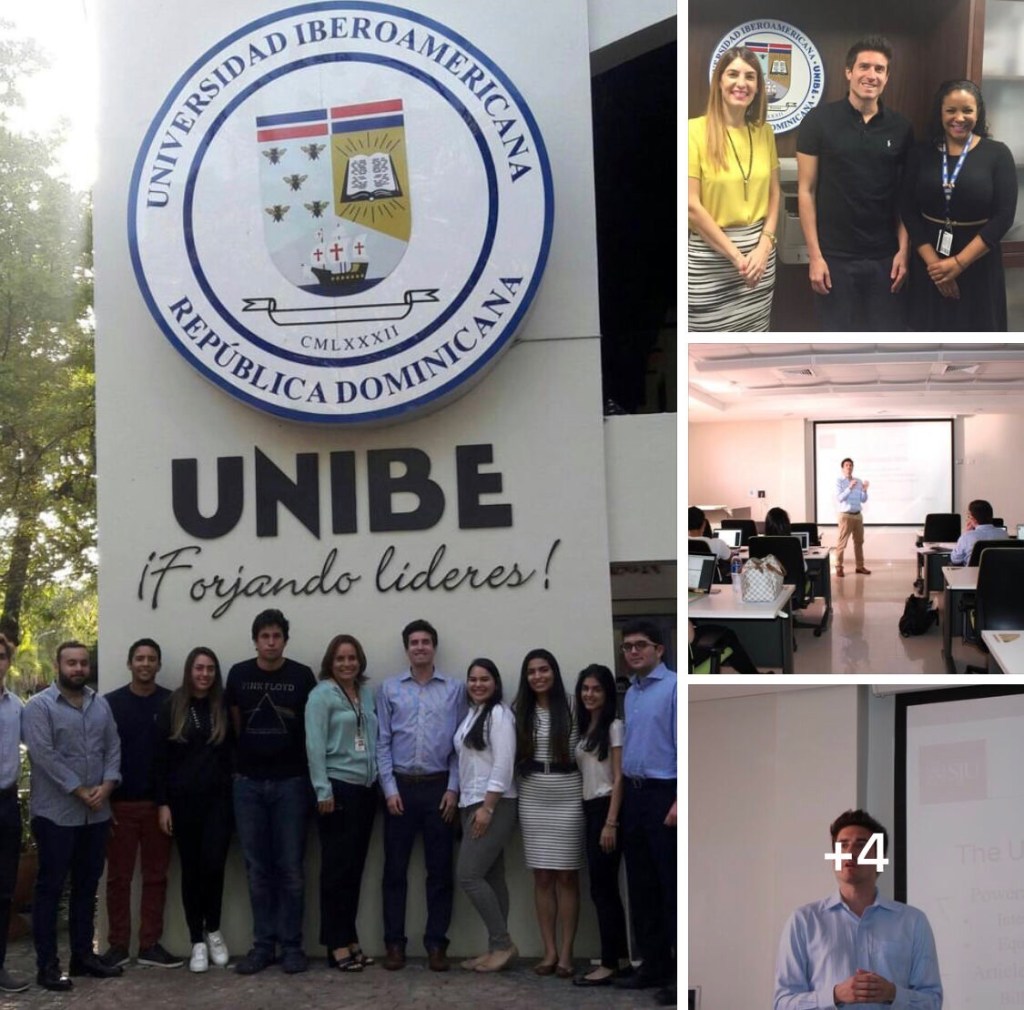
- While it’s more fun for me to teach a course in Santo Domingo (see above) or Shanghai, I can teach a course from anywhere in the world virtually. I tried this over the summer for a school in Shanghai and it was a lot of fun. Without the costs of travel and syncing schedules, will we see more schools embrace virtual/online? This can also be done for conferences, colloquium, and symposium speakers.
- Schools with larger budgets were able to have an advantage in securing partnerships due to the ability to travel more often and more extensively. The pandemic flattened the playing field and any savvy team was able to develop virtual connections with law schools around the world. If expectations return to in-person meetings and travel, will those schools have done enough during the pandemic to make the business case for travel and for students to enroll in their programs?
- A Whole New World: With so much online, students now see a whole new world (I’m an Aladdin fan!) of studying in U.S. law schools. Partnerships were able to focus the attention of students on specific schools while others weren’t there. Things like the EducationUSA Fairs and LL.M. Consortium groups now make it easy for any student, anywhere in the world, to hear from dozens of schools. With more students realizing they can go more places and secure scholarships similar to partner schools, will that change the calculus?
- Competition Abroad: While U.S. law schools like to think of themselves as the destination of choice for many international students, law schools in other countries have done a wonderful job of attracting students to their programs. Examples include 2+2 LLB programs where students get a first degree in law (e.g., in the UK), which U.S. law schools aren’t capable of competing with due to the J.D. degree. Schools in some countries are significantly cheaper. Others are in countries that are doing more to attract international students. Without the student mobility, how many partnerships can withstand, especially if money and resources are being poured into the faculty activities?
Advice for Schools New to Partnerships
In my opinion, it’s never been easier for a school outside the United States to set up a bilateral partnership with an American law school. Some honest suggestions for schools, especially those that have either not set up partnerships before or are still relatively new to the field.
- Do you have student demand and capacity to study at a law school in the U.S.? Partnerships are easy to set up but take time and effort to cultivate and maintain. If you do not think your students are interested in studying in the U.S. and would have the ability to do so, it may be harder to get the attention of U.S. law schools. My suggestion to U.S. law schools is to consider ways to use virtual to build partnerships even in these situations to still get benefits from internationalization.
- Do your research by Googling the names of U.S. law schools and global partners or exchanges. Or look at other schools in your country to see which schools they partner with. It’s a bit counterintuitive, but I’d suggest reaching out to schools that already have partners rather than ones that don’t. Those schools probably already have well-defined processes and abilities to service partners. Schools without large partner networks may not have the capacity to service partners, they may be focused on other types of activities, or they may have growing pains trying to work with you to build out partnerships.
- If you decide to enter into a partnership, figure out ways to grow beyond just student mobility. While that’s likely an important factor, see if the school can send a professor for a course. See if the school has alumni practitioners who would be interested in coming down to teach a short course. See what areas of mutual strength you could build a conference or symposium around. The best advice I received on faculty exchanges is to have one of your professors visit that school as a faculty scholar before the partnership to evaluate and to champion the school if you enter into a partnership.
 Beyond Non-JD | by Joshua Alter
Leave a comment