If you are connected in any way to legal education in the U.S., you know that the latest U.S. News & World Report rankings have arrived. Twitter and Reddit offer glimpses into how law schools, 0Ls, J.D. students, and faculty are taking the news. As usual, there are calls to reform the system. There are questions about the latest tweaks to the factors and weights. We now move ahead to the next cycle: we’ll review ABA employment data later this Spring and review entering classes and bar passage results over the Fall.
With one giant caveat. We’ll review J.D. numbers. J.D. employment data, J.D. bar passage, J.D. entering credentials. What about the Non-J.D. students? Well, for purposes of the USNWR rankings, it’s like they don’t exist. As questions about the rankings and legal education are brought up, I hope more people will consider incorporating Non-J.D. students into these discussions.
U.S. law schools continue to increase the raw number of Non-J.D. students, the percentage of Non-J.D. students in their law school classes, and their strategic importance to revenue. Professor Derek Muller does a great job tracking this information each year, and I encourage readers to read his blogs from 2020 and earlier years (including his chart below). According to Professor Muller’s 2020 update, “Almost 16% of law school enrollees, nearly 1 in 6, are not enrolled in a JD program.”
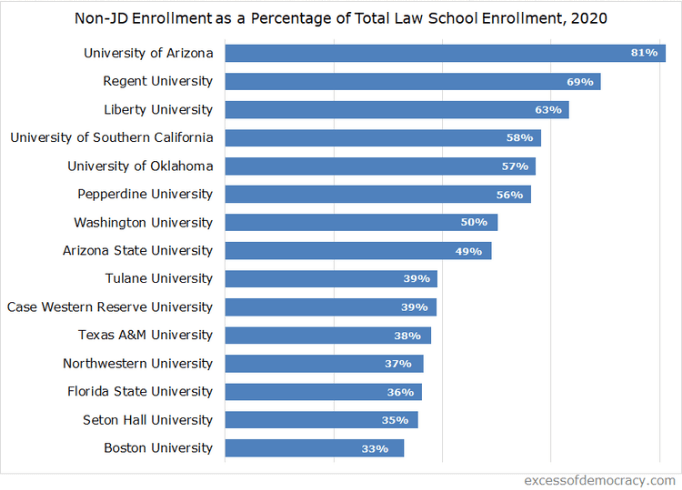
The problem is that Non-J.D. doesn’t adequately describe the different programs that fall under this umbrella. A residential General LL.M. program that markets itself as helping foreign-educated lawyers pass a state bar examination and assisting in securing legal employment (even for just an OPT) is quite different than an online, asynchronous program for mid-career U.S. attorneys to obtain an additional credential or transition into a new field. That is to say nothing of the programs that are now designed for those without a law degree or legal training. S.J.D./J.S.D. students seeking to become professors abroad, online LL.M. degrees, and the growing list of other programs further complicate matters.
Should Non-J.D. programs be included in USNWR rankings?
- USNWR markets its rankings as “Best Law Schools.” If we’re focused on J.D. programs, I think that should be more explicit. If employment opportunities, bar passage outcomes, instructors, and entering credentials are different, that should be noted.
- Just because the ABA acquiesces to Non-J.D. Programs does not diminish their importance to students who enroll in these programs and pay tuition to attend the same law schools. The ABA requires disclosures for J.D. programs (509, employment, and bar passage), but how would those look for Non-J.D. programs?
Now comes the difficult part. How would incorporating Non-J.D. Programs into USNWR rankings look? Residential LL.M. programs for foreign lawyers look the most like J.D. programs in a number of important ways (inputs and outputs), but things get more complicated for other programs. Including only these programs would incentivize schools to shrink LL.M. programs for foreign-educated lawyers in favor of programs with more difficult to quantify outcomes.
Over 2021-22, I’m going to spend a lot of time thinking through the direction of Non-J.D. Programs. To start off:
- Non-J.D. Programs are so different that they cannot be viewed monolithically. Reasons for attending, experiences, and outcomes are drastically different between programs.
- If disclosures are important for J.D. programs, I am not sure why they wouldn’t be important for Non-J.D. programs. There are now 2-year J.D. programs for foreign lawyers. There are also two-year LL.M. programs. So it’s not the number of years of study. A decade ago, the transparency movement helped 0Ls in deciding on law schools by bringing important information to their fingertips. A similar movement should now help Non-J.D. students.
- USNWR is likely a better vehicle for progress for Non-J.D. students given ABA acquiescence to these programs. To the extent they even did reputational surveys for the programs (like their specialty rankings), that would show that Non-J.D. programs are part of the overall law school. General LL.M., M.S.L., S.J.D./J.S.D., and perhaps one overarching Non-J.D. Programs? The ABA looking more carefully at Non-J.D. Programs would be another good option, but that gets more complicated given the current description (“an ABA-approved law school may not establish a degree program other than its J.D. degree program unless the school is fully approved, and the additional degree program will not detract from a law school’s ability to maintain a sound J.D. degree program.”)
- I feel like this will be an important year for Non-J.D. programs at U.S. law schools. Given the inability for a lot of foreign-educated students to attend residential programs in 2020-21, schools that were well positioned with online programs, programs for non-lawyers in the U.S., and programs for U.S. lawyers seemed to do better on the ABA Statistics for Non-J.D. Programs. Some schools that were focused on “traditional” LL.M. programs were left scrambling.
- Foreign-educated lawyers in LL.M. programs require a lot more resources (e.g., employment, bar support, academic support). I can see more foreign lawyers opting for either the two-year J.D. programs (especially those that don’t require LSATs/GREs) or the new online LL.M. degrees (possibly in combination with D.C. Bar requirements that some are already completing outside degree programs in other countries). As the focus moves away from “the General LL.M.” at some schools, how will that change international recruitment, partnerships, exchanges, and other activities?
Still a lot to consider, but hopefully a start!
 Beyond Non-JD | by Joshua Alter
Leave a comment